
- Pleasanton Water
- About Our Water
- Water Quality & Safety
- Investing in the Future
- Sewer Service & Programs
- Customer Service & Utility Billing
- Water Conservation Programs
- Water Rates
- Sewer Rates
- Recycled Water Program
- Near-Term Water Improvement Projects
- Groundwater Supply Project
- Water Meter Replacement Project
- Cross-Connection Control & Backflow Prevention Program
- Clean Water Program
Groundwater Supply Project
The City of Pleasanton has historically relied on local groundwater wells to supply up to 3,500 acre-feet of water per year (the City’s groundwater production quota, or GPQ), representing about 20 to 30 percent of the City’s total water supply needs. The City purchased its remaining water supply from the Zone 7 Water Agency (Zone 7). Zone 7 is a water wholesaler that procures and treats water from the California Department of Water Resources (DWR) and produces water from its groundwater wells to sell to Tri-Valley water retailers, like the City of Pleasanton, for distribution to its customers.
In 2019, PFAS (per- and polyfluoroalkyl substances) were detected in the City’s groundwater wells at concentrations exceeding state advisory levels, and by 2022, all three City wells had been taken out of service. PFAS also affected some of Zone 7’s joint groundwater wells (see Zone 7 PFAS Information for details). With its wells out of service, Pleasanton became fully reliant on imported water purchased from Zone 7 (see Pleasanton Water’s Water Quality page for details).
In October 2022, the City launched a Water Supply Alternatives Study to assess multiple strategies to restore its local water supply, including rehabilitating the City’s existing wells with PFAS treatment, developing new groundwater wells, and continuing to rely entirely on purchased water from Zone 7. The study identified developing new groundwater wells as the most economical and reliable long-term path forward.
On October 17, 2023, the City Council approved proceeding with planning for new groundwater wells within the Bernal subbasin (believed to be outside the known PFAS footprint based on Zone 7 testing and groundwater modeling) to restore a reliable, long-term local groundwater supply. On June 18, 2024, the City Council approved an agreement with Zone 7 to evaluate the feasibility of jointly constructing and operating these new groundwater wells, known as the Groundwater Supply Project.
The City and Zone 7 completed a Regional Groundwater Facilities Project Feasibility Study in December 2025 that determined a new groundwater project in the Bernal subbasin was technically feasible and that the City and Zone 7 doing so jointly would provide cost savings for both agencies. The study also identified Pleasanton Tennis and Community Park and Hansen Park as preferred locations for new wells. On April 21, 2026, the City Council approved moving forward with the joint project. On September 1, 2026, the Council authorized the City Manager to execute an agreement with Zone 7 to advance the design, construction, and operation of the new groundwater facilities.
Project Overview
The City of Pleasanton and Zone 7 are working together to develop a new groundwater supply project. The Groundwater Supply Project will restore up to 3,500 acre-feet of local groundwater annually for the City and provide nearly 10,000 acre-feet of groundwater supply for the region in an average year. This will, in turn, help to diversify water supplies, reduce reliance on imported water, improve long-term water reliability and drought resilience, and provide greater stability in water supply costs over time.
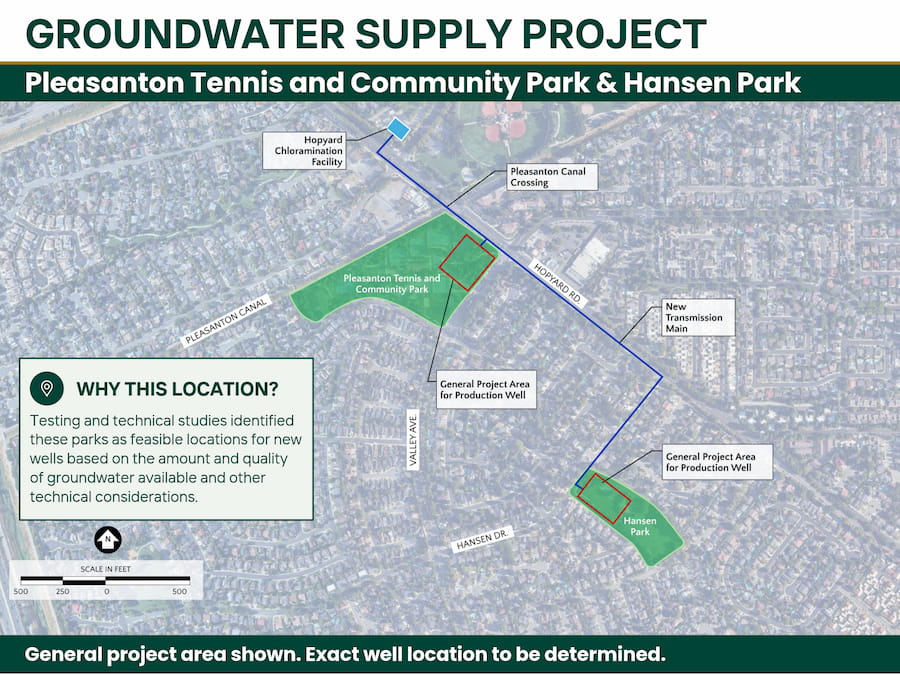
The project will construct the new wells at Pleasanton Tennis and Community Park and Hansen Park in the Bernal subbasin. The feasibility study identified these sites as preferred based on testing and groundwater modeling. Both sites are outside areas with known PFAS detections.
Regional Groundwater Development
Led by Zone 7 in partnership with the City, this component includes:
- Constructing two new groundwater wells in the Bernal subbasin at Pleasanton Tennis and Community Park and Hansen Park.
- Connecting the new wells to Zone 7’s water supply system and upgrading its Hopyard Chloramination Facility to treat the additional groundwater.
Zone 7 will serve as the lead agency for permitting, design, and construction of the regional groundwater facilities and will own, operate, and maintain them once completed. This includes the turnouts used to deliver the City’s groundwater production to the City’s system.
The City will support Zone 7 by overseeing public outreach, helping secure necessary land rights, and paying its share of project costs. Under the partnership, Pleasanton will receive its groundwater allocation through Zone 7’s water system rather than directly from dedicated City wells, as it did previously.
City Groundwater Distribution Improvements
Led by the City, this component improves the City’s water distribution system to receive groundwater from Zone 7’s regional facilities and deliver it to Pleasanton water customers.
Planned improvements include:
- Replacing some existing water pipes with larger ones to accommodate the additional water supply.
- Building a new turnout connection between Zone 7’s water system and the City’s water system.
The City will oversee and pay for these improvements. Together with the regional groundwater facilities, they will allow Pleasanton to once again receive its share of local groundwater, helping ensure a reliable water supply for the community.
Project Schedule
The Groundwater Supply Project’s expected schedule includes the following milestones:
- Feasibility Study — Completed December 2025. The City and Zone 7 evaluated the technical feasibility of developing new groundwater wells in the Bernal Subbasin. The study determined that new groundwater wells are technically feasible. The study identified Pleasanton Tennis and Community Park and Hansen Park as preferred locations for the new groundwater wells.
- Design & Pre-Construction — 2026-2028. Activities will include project design, environmental review, permitting, and other preparations for construction.
- Construction — 2028-2029. Work will include building new groundwater wells, connecting them to Zone 7’s water system, upgrading the Hopyard Chloramination Facility, and improving the City’s water distribution system.
- New Facilities Operational — By 2030. The new facilities are expected to begin delivering groundwater to Pleasanton and the surrounding region.

Note: The schedule is subject to change as the project moves forward.
Project Status
With the feasibility study complete and City Council’s approval to move forward, the Groundwater Supply Project is advancing into the Design and Pre-Construction phase.
The City and Zone 7 are preparing for the next steps, including project design, environmental reviews, permits, and construction preparations. This work will support both the new regional groundwater facilities and the improvements needed to deliver water to Pleasanton customers.
How the City Evaluated Its Options
Before moving forward with the Groundwater Supply Project, the City worked with Zone 7 to thoroughly evaluate potential well locations, groundwater quality and availability, and the costs and benefits of different options.
This research and testing helped the City develop a plan intended to provide a safe, reliable, and cost-effective water supply for Pleasanton residents and businesses. The evaluation included four key activities:
- Well Siting Evaluation: A study completed in June 2024 identified Del Prado Park, Pleasanton Tennis and Community Park, and Hansen Park as the top locations for potential groundwater facilities. These locations offered several advantages: the City already owns the land, they are close to Zone 7’s Hopyard Treatment Facility, they have enough space for construction and operation, and they are believed to be outside the area of known PFAS contamination.
- Test Well Construction: The City constructed test wells at Del Prado Park in January 2025, Tennis and Community Park in March 2025, and Hansen Park in May 2025. This testing helped the City and Zone 7 determine how much groundwater might be available and evaluate its quality.
- Feasibility Study: Completed in December 2025, the study looked at potential groundwater production, water quality, the long-term sustainability of the groundwater basin, project costs, and construction requirements. It confirmed that a joint groundwater project in the Bernal Subbasin is technically feasible and identified Pleasanton Tennis and Community Park and Hansen Park as preferred locations for new wells.
- Cost-Benefit Analysis: The City compared developing new groundwater facilities jointly with Zone 7 against pursuing a City-only project. The analysis considered costs, long-term water supply reliability, flexibility in managing water supplies, groundwater sustainability, and potential community impacts. It found that the joint project would have lower annual costs than the alternatives and that construction costs were consistent with assumptions in the City’s 2025 Water Rate Study. Based on the analysis, the City Council approved moving forward with the joint project in April 2026.
Project FAQs
What is the Groundwater Supply Project?
The Groundwater Supply Project is an effort by the City of Pleasanton to restore Pleasanton’s access to local groundwater and improve water supply reliability and long-term costs.
The project includes two parts: Regional Groundwater Development, led by Zone 7 and co-funded with the City, and City Groundwater Distribution Improvements, solely funded and managed by the City, to receive and deliver the additional water to its customers.
Why is this project needed?
The City’s existing groundwater wells have been out of service since 2022 due to PFAS detections. As a result, the City purchases all its water from Zone 7. The project will help restore access to local groundwater, provide more options for meeting the City’s water needs, lower the long-term water supply costs, and improve water supply reliability during droughts.
What are groundwater wells and how do they work?
Groundwater wells are vertical shafts drilled into the ground to reach underground water sources, called aquifers. A pipe with openings allows groundwater to enter the well while keeping soil and debris out. Pumps then bring the water to the surface, where it can be treated and delivered to customers.
The Groundwater Supply Project will develop two new groundwater wells to replace the supply lost when Pleasanton took its existing wells out of service.
What are PFAS
PFAS (per- and polyfluoroalkyl substances) are a group of synthetic chemicals designed to resist heat, water, and oil. PFAS are used in a wide range of industrial and consumer products, including firefighting foams, stain- and water-resistant clothing, carpets, cleaning products, non-stick cookware, and food packaging.
PFAS have been found in air, soil, and water worldwide and persist in the environment. They can accumulate in the human body over time and are toxic at relatively low concentrations. Scientific studies have shown that exposure to some PFAS in the environment may be linked to harmful health effects in humans and animals. Although certain PFAS are no longer manufactured in the U.S., these chemicals are still produced internationally and imported into the U.S. in consumer goods. PFAS have been found in groundwater in parts of the Livermore-Amador Groundwater Basin.
For additional information about PFAS, see the Pleasanton Water webpage.
What is the timeline for this project?
The feasibility study was completed in December 2025. Design and Pre-Construction activities are expected to continue through 2028, followed by construction in 2028-2029. The new facilities are expected to be operational by 2030.
See the Anticipated Project Schedule above for more information. Dates are subject to change as the project moves forward.
Where will the new wells be located?
The City and Zone 7 evaluated three City-owned parks as potential locations:
- Pleasanton Tennis and Community Park (5801 Valley Ave.)
- Del Prado Park (5196 Golden Rd.)
- Hansen Park (5697 Black Ave.)
Based on groundwater testing and a feasibility study, Pleasanton Tennis and Community Park and Hansen Park were identified as the preferred locations for the two new groundwater wells. Exact well locations will be determined during project design.
How were these well sites selected?
The City and Zone 7 selected the sites for the following reasons:
- City ownership of the land, allowing for easier implementation
- Proximity to Zone 7’s Hopyard Treatment Facility for cost efficiency
- Sufficient space for construction and operation
- Likelihood of being outside of the known PFAS groundwater footprint
How can I stay informed or provide input?
Residents can also sign up for the Pleasanton Pipeline e-newsletter and monitor the City’s social media pages to stay informed on the project.
For updates on the regional groundwater facilities, visit Zone 7 Water Agency’s project webpage.
To provide input, contact the City’s Public Works Department via our contact form or by calling (925) 931-5500.
Additional Information
The following resources provide more information about the project’s development and key City Council decisions:
- September 1, 2026: The City Council authorized the City Manager to negotiate and execute an agreement with Zone 7to advance the joint groundwater project
- April 21, 2026: The City Council approved moving forward with the joint project in partnership with Zone 7 after completing the feasibility study. View the Press Release.
- December 2025: The City and Zone 7 completed a Regional Groundwater Facilities Project Feasibility Study that confirmed the project’s technical feasibility and identified preferred well locations.
- June 18, 2024: The City Council approved an agreement to partner with the Zone 7 Water Agency to evaluate the feasibility of jointly developing the new wells.
- May 7, 2024: The City Council approved the execution of a $19 million water revenue bond to assist in financing improvements to the City’s water system, including the feasibility phase of the groundwater project.
- October 17, 2023: The City Council considered the Water Supply Alternatives Study and approved moving forward with planning for new groundwater wells in the Bernal Subbasin.
Should you have any questions or comments regarding the project, please contact the Public Works Department at (925) 931-5500.