
- Pleasanton Water
- About Our Water
- Water Quality & Safety
- Investing in the Future
- Sewer Service & Programs
- Customer Service & Utility Billing
- Water Conservation Programs
- Water Rates
- Sewer Rates
- Recycled Water Program
- Near-Term Water Improvement Projects
- Joint Groundwater Supply Project
- Cross-Connection Control & Backflow Prevention Program
- Clean Water Program
Sewer Rates
Pleasanton’s sewer rates fund the collection, transportation, treatment, and disposal of wastewater from homes and businesses throughout the community. Pleasanton’s sewer system is funded through a dedicated Sewer Enterprise Fund, which may only be used for sewer-related operations, maintenance, rehabilitation, replacement, capital improvements, and regulatory compliance activities. These funds cannot be used for water services, projects, or other general City expenses.
Pleasanton is committed to maintaining equitable and justifiable sewer rates that support the needs of the sewer system while ensuring long-term financial sustainability. Historically, Pleasanton has adjusted sewer rates primarily based on changes in the Consumer Price Index (CPI). While this approach helped keep rates stable, it did not fully account for the long-term costs of maintaining, rehabilitating, and replacing aging sewer infrastructure.
Sewer charges vary by customer type and include a combination of local sewer collection costs (i.e., City rates) and regional wastewater treatment costs. Depending on the customer type and location, sewer bills include charges from the City of Pleasanton and pass-through charges from Dublin San Ramon Services District (DSRSD) or the City of Livermore. Sewer rates are based on an estimated contribution to wastewater flows.
- Residential Pleasanton Sewer Fixed Charge: Residential sewer charges are based on estimated household wastewater generation and are billed as a fixed bi-monthly charge.
- Commercial Pleasanton Sewer Variable Charge: A variable charge based on winter water use from the prior calendar year.
- DSRSD/Livermore Sewer Charge: Covers wastewater treatment and disposal services provided by the regional treatment agency and is passed directly through to customers.
The City only controls and sets rates associated with Pleasanton’s sewer collection system. Treatment charges established by DSRSD and the City of Livermore are passed through to customers.
The Rate Setting Process
Maintaining a reliable sewer system requires long-term planning. Over the past several years, the City has completed a series of studies and planning efforts to better understand the condition of the sewer system, identify future infrastructure needs, and evaluate long-term funding requirements. The City’s rate-setting process is transparent, compliant with legal requirements, and informed by technical analysis and community input.
The City is currently conducting its first comprehensive sewer rate study, commissioned to help maintain the long-term reliability of the City’s aging sewer system and protect public health and the environment. The study evaluates the long-term funding needs of the sewer system and proposes updated sewer rates, sewer connection fees, and rate-structure changes that reflect operational, maintenance, infrastructure, and regulatory requirements.
Similar to the water rate-setting process, the City is implementing a three-step strategic approach to ensure sewer rates accurately reflect long-term system needs while maintaining consistency and financial health:
- Step 1: Update the City’s Sewer System Management Plan (SSMP) and develop a Long-Term Sewer Capital Improvement Plan
- Step 2: Perform a financial plan analysis to serve as the basis for the sewer rate study.
- Step 3: Prepare a Sewer Rate Study and Cost-of-Service Analysis to evaluate the financial condition of the sewer enterprise, ensure long-term financial sustainability, and establish rates that equitably recover the cost of providing service to all customer classes.
2026 Sewer Rate Update
To support implementation of the SSMP and maintain long-term financial sustainability, in 2026 the City completed a comprehensive Sewer Rate Study. The 2026 Sewer Rate Study included a cost-of-services analysis to ensure the City can continue to provide reliable sewer service while responsibly planning for future infrastructure needs.
On February 17, 2026, the Pleasanton City Council reviewed and approved the long-term financial plan developed as part of the sewer rate-setting process. The financial plan evaluated multiple funding scenarios at different levels of near-term investment and assessed their impact on long-term system risk.
After reviewing the analysis, the City Council selected the “Maintain” scenario as the preferred approach. This scenario reflects a balanced strategy that addresses high-priority infrastructure needs while sequencing other improvements over time to manage costs and long-term risk responsibly.
On April 21, 2026, the City Council held a public workshop to review initial findings and proposed updates to the 2026 Sewer Rate Study, including proposed sewer rate adjustments, changes to the rate structure, and updated sewer connection fees.
Subsequently, on June 2, 2026, the Pleasanton City Council officially approved moving forward with proposed updates to the City’s sewer rate structure, sewer rates, and sewer connection fees to support implementation of the Sewer Rate Study’s Financial Plan Maintain scenario.
On July 27, 2026, the City Council accepted the final Sewer Rate Study and initiated the Proposition 218 public review process for proposed updates to the City’s sewer rates and rate structure. The proposed rates will be considered at a public hearing on Tuesday, November 17, 2026 at 7:00 p.m. If adopted, the first rate adjustment would take effect January 1, 2027.
Proposed Sewer Rates & Connection Fees
Since the City has historically relied primarily on CPI to determine changes to sewer rates, rates have not kept pace with the long-term costs of adequately maintaining, rehabilitating, and replacing its aging sewer system. The 2026 Sewer Rate Study aligns rates more closely with cost-of-service principles, simplifies the rate structure, and updates sewer connection fees to reflect the capacity costs of new development.
The 2026 Sewer Rate Study includes a cost-of-service analysis that evaluates how wastewater is generated by different customer types and allocates costs proportionally based on estimated wastewater flows.
Residential wastewater flows are estimated based on household size and indoor water-use characteristics. Commercial, industrial, and institutional wastewater flows are estimated using actual water usage data and established industry methodologies. This approach helps ensure rates are fair, equitable, and proportional to the cost of providing sewer service to each customer class.
Rate adjustments have been proposed for the next four years (FY 2027-FY 2030) beginning January 1, 2027, for single-family, condominium, multifamily, commercial, industrial, and school customer classifications. Proposed rate changes vary by customer type as described below.
Proposed Residential Sewer Rates and Structure Changes
Below is a summary of the recommended rate structure changes and preliminary rate impacts for residential sewer customers:
- The City’s sewer rate is expected to increase by approximately $25.50 per bimonthly billing cycle, or $12.75 per month, in the first year.
- A combined bimonthly sewer bill for single-family homes would increase from $93.28 to $122.61 under the proposed FY 27 rates, including DSRSD pass-through rates. This is an increase of $29.33 per billing cycle, or $14.67 per month.
- For condominium and multifamily customers, a single, consistent rate structure is proposed. This would align more closely with DSRSD’s practices and wastewater flow characteristics. The rate would be $39.51 per billing cycle in FY 27, compared to the current rates of $21.65 for condominium and $16.49 for multifamily customers.
- View the proposed City residential sewer rates.
- View the overall customer impact for residential customers in Year 1.
- View sewer rate survey comparison for single-family residential customers.
Commercial and Industrial Sewer Rate and Structure Changes
The Sewer Rate Study found that the City’s existing commercial rate structure does not always reflect current wastewater flow patterns. As a result, the proposed rate structure simplifies sewer charges and more closely aligns them with each customer’s estimated contribution to the sewer system, regardless of business classification.
Beginning January 1, 2027, commercial and industrial customers would be billed using a single collection rate based on actual water usage rather than separate rates tied to specific business categories. The proposed rate structure would also include a minimum bi-monthly charge equal to the multifamily residential rate, set at $39.51 in FY 2027.
Under the proposed FY 27 rates, for example:
- An office or retail customer categorized as “All-Other” would see a combined bimonthly sewer bill increase from $499.94 to $741.18, which is a difference of $241.24 per billing cycle, or $120.62 per month.
- A full-service restaurant would see its combined bimonthly sewer bill increase from $1,332.74 to $1,704.24, a difference of $371.50 per billing cycle, or $185.75 per month.
View the overall customer impact for non-residential customers in Year 1.
View sewer rate survey comparison for a full service restaurant.
Sewer Connection Fee Changes
At its November 17 meeting, the City Council will also consider updated sewer connection fees for new development or changes in use that increase demand on the sewer system. Connection fees are not part of the Proposition 218 public hearing or protest process for the proposed sewer rates.
Sewer connection fees are one-time charges designed to recover a share of the costs of sewer infrastructure and are intended to be allocated proportionately between new and existing ratepayers.
The proposed update would increase the single-family sewer connection fee from the current $556.24 to $2,250, effective in FY 27. Most of this fee is associated with regional treatment capacity charges established by DSRSD.
Timeline, Activities, and Next Steps
| Date | Milestone |
| February 17, 2026 | City Council Meeting: Financial Plan Analysis (Staff Report, PowerPoint, Video) |
| April 21, 2026 | City Council Special Meeting Workshop: Update on the 2026 Sewer Rate Study (Staff Report) |
| June 2, 2026 | City Council Meeting: Approve the Proposed Sewer Rate Structure, Sewer Rate, And Updated Sewer Connection Fees (Staff Report, Technical Memo: Rate Scenarios, Technical Memo: Proposed Rates & Connection Fees, PowerPoint) |
| July 9, 2026 | 2026 Sewer Rate Webinar: Understanding Proposed Changes to Sewer Rates (Video, Powerpoint) |
| July 23, 2026 | City Council 2026 Sewer Rate Information Session at the Pleasanton Senior Center |
| July 25, 2026 | Community Outreach Booth at the Pleasanton Farmers’ Market |
| July 27, 2026 | City Council Meeting: Approve Prop 218 Notice, Accept Rate Study Report |
| September 18, 2026 | Last Day to Mail Proposition 218 Public Hearing Notices, Mailed at least 60 Days Before Public Hearing |
| November 17, 2026 | City Council Public Hearing and Potential Rate Adoption |
| January 1, 2027 | New Rates Take Effect for Next Four Years |
Any proposed sewer rate adjustments will be subject to public review under Proposition 218 before adoption. Ongoing updates will be posted to this webpage as they are announced. To stay informed about the sewer rate setting process, sign up for the Pleasanton Pipeline Quarterly e-Newsletter.
Questions About the Sewer Rate Study?
Find answers to common questions about the City’s Sewer Rate Study, sewer rates, customer billing, and wastewater services. The following frequently asked questions reflect questions received during public meetings, outreach events, and throughout the Sewer Rate Study process. Similar questions have been combined and edited for clarity.
Questions not addressed below may be submitted to [email protected]
Why is a sewer rate study necessary?
The City of Pleasanton must regularly assess its water and sewer rates and fees to ensure they sufficiently cover the City’s costs to provide service. The City relies on sewer rate revenues to fund the operations and maintenance of its sewer collection system.
To adjust rates, a sewer rate study is necessary to ensure that sewer rates are financially sustainable, legally compliant, and sufficient to maintain reliable wastewater service for the community.
The study evaluates the actual cost of operating, maintaining, repairing, and replacing the City’s aging sewer infrastructure, while also accounting for increasing regional treatment costs charged by Dublin San Ramon Services District, inflation, regulatory requirements, and long-term capital improvement needs.
Sewer systems require continuous investment to reduce the risk of pipe failures, sewer overflows, service disruptions, and costly emergency repairs. Much of Pleasanton’s sewer infrastructure was installed decades ago and must be rehabilitated or replaced over time to support the long-term reliability of the system and protect public health and the environment.
This is the first time Pleasanton sewer rates have been comprehensively evaluated with a cost-of-service analysis designed to right-size and more equitably distribute costs across customer classes. For many years, the City relied on CPI-based adjustments, which did not generate sufficient revenue to operate, maintain, and rehabilitate the sewer system. This has resulted in significant deferred maintenance needs and costly emergency repairs.
This rate study helps the City:
- Determine whether sewer rates are sufficient to cover the cost of service, i.e. operating and maintenance costs
- Plan for funding future infrastructure rehabilitation and replacement, estimated at more than $55 million over the next four years
- Ensure rates are fair, proportional, and compliant with California legal requirements for utility fees
- Avoid sudden large rate increases by implementing gradual, predictable adjustments over time
When was the last time Pleasanton conducted a sewer rate study?
Historically, Pleasanton has taken a conservative approach to its sewer rates, making adjustments tied to changes in the cost of living.
The last comprehensive sewer rate review was completed in 2022, when the City adopted the current sewer rate schedule and authorized annual adjustments based on the Consumer Price Index (CPI) rather than conducting a full cost-of-service reevaluation each year.
Since then, Pleasanton’s sewer rates have only been adjusted annually through CPI-based increases to keep pace with inflation and routine operating cost changes. For example, the current 2026 local sewer rates reflect a 2.48% CPI adjustment. Overall, since 2018, the City’s sewer rates have increased by only $5.58 for residential customers, an average of $0.80 per year.
This year, the City is conducting its first comprehensive sewer rate study as part of the broader sewer financial planning process. The study is evaluating long-term system needs, updated capital improvement requirements identified through the City’s new Sewer System Management Plan (SSMP) and Long-Term Capital Improvement Plan (approved last year), regional treatment cost impacts, and overall financial sustainability to establish rates that are cost-based, legally compliant, and sufficient to address the City’s aging sewer system over the next several years.
Why is it important that Pleasanton conduct a comprehensive sewer rate study now?
The City must adhere to strict state and federal standards and is dedicated to meeting these through responsible planning and investments. Since 2023, the City has adopted a strategic and systematic approach to addressing its aging water and wastewater systems. Last year, the city adopted an updated Sewer System Management Plan (SSMP) to establish a complete and comprehensive sewer management program that supports required operations and maintenance, repair and replacement, and capital improvement program (CIP) projects to meet the minimum State requirements for effective sewer system management and to maintain compliance with all sanitary sewer regulatory requirements.
A key driver for this timing is compliance with the State Water Resources Control Board’s requirements under the SSMP framework. The SSMP requires agencies, like Pleasanton, to not only properly maintain and operate their sewer systems, but also to demonstrate ongoing financial and capital planning capacity to support system maintenance, rehabilitation, and spill prevention. In other words, regulatory compliance requires that the City maintain a documented, sustainable funding strategy to implement the SSMP over time.
While annual CPI adjustments help maintain short-term financial stability, they do not assess whether rates are sufficient to meet long-term infrastructure, regulatory, and capital project needs. A comprehensive rate study ensures the City ties SSMP requirements to a defensible cost-of-service analysis and can demonstrate adequate financial capacity during State audits or regulatory reviews.
What does the sewer rate pay for?
Sewer rates fund the full cost of safely collecting and transporting wastewater to regional treatment facilities for responsible treatment and discharge. This includes ongoing operations, maintenance, and capital investments in the City’s aging wastewater system to ensure it can safely transport wastewater, protect the environment, and safeguard public health.
More specifically, sewer rates support system-wide requirements such as:
- Collection and transport of wastewater through the sewer system
- Wastewater treatment and environmental compliance
- Operation, maintenance, repair, and replacement of aging infrastructure
- Long-term capital planning and infrastructure investments
- Emergency preparedness and response capabilities to protect public health and the environment
- Regulatory compliance and reporting under State and federal wastewater permits
Providing reliable sewer service requires continuous, 24-hour operation of both the City’s local collection system and the regional wastewater treatment facilities operated by Dublin San Ramon Services District (DSRSD) or the City of Livermore.
The proposed sewer rate adjustments support both the ongoing operation of the sewer system and long-term infrastructure investments. Based on the financial analysis completed for the Sewer Rate Study, approximately half of the proposed increase is associated with capital improvement projects and related debt financing, while the remaining portion addresses increasing operating costs and existing operating deficits.
In Pleasanton, customers pay two sewer rates: a City rate to collect and transport the wastewater and a pass-through rate from the Dublin San Ramon Services District or the City of Livermore (Ruby Hill only) for wastewater treatment and discharge.
City sewer rates pay for the operation, maintenance, inspection, cleaning, repair, and replacement of the City’s sewer collection system. This includes approximately 253 miles of gravity pipelines, 4.9 miles of force mains, 8 siphons, 11 lift stations, 6,032 manholes, routine sewer cleaning and inspections (including closed-circuit TV inspections), root control, emergency response to sewer blockages and overflows, regulatory compliance under the State’s Sewer System Management Plan (SSMP), and long-term capital improvements needed to rehabilitate the City’s aging infrastructure and prevent dangerous sewer spills and failures.
At the regional level, sewer rates fund wastewater transport, treatment, and disposal after the wastewater leaves the City’s system for treatment at the DSRSD or Livermore treatment facilities. These costs also include operating regional interceptor pipelines, running advanced treatment processes to meet state and federal water quality standards, managing biosolids, maintaining treatment plant facilities, and ensuring compliance with environmental discharge permits. These rates are established by DSRSD or the City of Livermore as a pass-through and are not established by the City of Pleasanton.
The Sewer Rate Study also includes funding to maintain appropriate operating reserves as part of responsible financial planning. Maintaining reserves helps ensure the sewer utility can respond to emergencies, manage unexpected expenses, support capital improvement projects, and maintain reliable sewer service over the long term.
Together, these investments help ensure Pleasanton’s sewer system remains safe, reliable, environmentally responsible, and capable of serving the community for years to come.
What are the different sewer rates charged by the City?
Residential customers are charged a fixed sewer rate regardless of how much wastewater an individual household generates. Pleasanton’s residential sewer charge is structured as a fixed charge because the City’s sewer collection system costs are largely independent of day-to-day water use. Unlike water rates, which are based on metered water consumption, residential sewer rates are based on average indoor water use assumptions informed by data from the American Community Survey and industry standards.
Commercial, industrial, and institutional customers are charged a variable sewer rate based on estimated wastewater flow, as determined by their winter water usage, and strength characteristics associated with their type of business or facility.
Regional wastewater treatment charges from Dublin San Ramon Services District (DSRSD) or the City of Livermore are also included as a pass-through charge on customer bills and vary depending on the customer classification and treatment requirements. These rates are not set or controlled by the City.
Why are sewer rates different for single-family and multifamily homes?
Sewer rates are developed using a cost-of-service analysis that allocates costs fairly among customer classes. Residential sewer rates are based on average household occupancy. Current demographic data indicates that single-family homes have a higher average household size than multifamily residences, resulting in higher estimated wastewater generation and a correspondingly higher sewer rate for single-family customers.
When did DSRSD rates last change, and from what amount to the current amount?
The most recent rate adjustment for DSRSD’s regional sewer services affecting Pleasanton customers took effect July 1, 2025. The bi-monthly fixed single-family residential charge increased from $59.97 to $61.58.
Based on the cost-of-services study adopted by DSRSD board in May 2026, the updated rates will take effect on July 1, 2026. The bi-monthly fixed single-family residential charge for regional sewer services will increase from $61.58 to $65.58.
How does Pleasanton provide input on DSRSD regional wastewater treatment rates?
DSRSD provides regional wastewater treatment services and disposal to Pleasanton by contract. The DSRSD regional wastewater treatment charge shown on Pleasanton customer bills is a pass-through charge that is collected by the City and remitted directly to DSRSD. The 1992 contract requires DSRSD to provide notice to Pleasanton when rate adjustments are being considered. In addition, Pleasanton and DSRSD staff coordinate throughout the development of the cost-of-service study, and Pleasanton has an opportunity to review and provide input to the adoption of new regional wastewater treatment rates.
Why are DSRSD sewer rates lower than the City's sewer rates?
The City of Pleasanton and Dublin San Ramon Services District (DSRSD) provide different sewer services and independently establish their rates based on their respective operating costs, infrastructure responsibilities, capital improvement needs, reserve policies, and long-term financial planning.
The City owns, operates, and maintains Pleasanton’s sewer collection system, while DSRSD provides regional wastewater treatment services. Because each agency has different responsibilities and financial needs, their sewer rates are established independently and are not directly comparable.
How often can the DSRSD charge be adjusted?
Periodically, DSRSD conducts a comprehensive cost-of-service study for regional wastewater treatment to ensure adequate revenues to fund operations, maintenance, and capital replacement needs. DSRSD completed the most recent
DSRSD completed the most recent cost-of-service study in May 2026, and a new five-year rate schedule of rate adjustments was adopted for the next five fiscal years (starting July 1, 2026). Even with the new rate increases, DSRSD’s regional wastewater rates remain among the lowest in Alameda and Contra Costa Counties.
To learn more about DSRSD and its rates, please visit the District’s webpages for Residential and Non-Residential Wastewater Rates. View this webpage for past rate studies.
How long does the contract run with DSRSD?
Dublin San Ramon Services District (DSRSD) has been providing wastewater treatment services to the City of Pleasanton under contract since September 1965. The most recent version of the Agreement for Wastewater Disposal Services was signed in 1992 and remains active today, with no expiration date.
Can the City use funds from sewer rates for other uses?
No. Pleasanton’s sewer system is funded through a separate Sewer Enterprise Fund that covers sewer-related services and infrastructure. Under California Proposition 218, sewer rate revenues may only be used for the operation, maintenance, repair, replacement, and improvement of the sewer system.
Sewer rates directly support only the costs associated with the City’s sewer operations, maintenance, capital improvements, and wastewater treatment services. Property tax revenues are not used to fund sewer capital improvement projects, and sewer rate revenues cannot be used for unrelated City services or General Fund purposes.
Does any portion of property taxes pay for sewer capital improvement projects?
No. The City’s sewer system is funded through the Sewer Enterprise Fund, which is separate from the General Fund and property tax revenues. Sewer capital improvement projects are funded through sewer service charges paid by customers. Under California Proposition 218, sewer rate revenues may only be used for the operation, maintenance, repair, and improvement of the sewer system.
How is the City's Utility Discount Program funded?
The Utility Discount Program is funded through the City’s General Fund, not the Sewer Enterprise Fund. The program provides a 30% discount on qualifying City water and sewer charges for eligible households. Funding is capped at $425,000 per fiscal year and is available on a first-come, first-served basis for eligible applicants.
To qualify, customers must first be enrolled in PG&E’s CARE Program and then apply through the City’s Utility Billing Division.
For complete information about the Utility Discount Program, including eligibility requirements, funding availability, and how to apply, visit the Utility Billing webpage.
What are connection fees?
Connection fees are one-time capital fees assessed against new developments in the City to recover the proportional share of capital facility investments to be constructed or previously constructed for the sewer system to accommodate new growth.
How can I stay informed about the 2026 Sewer Rate Update?
Sign up for the City’s special edition, Pleasanton Pipeline e-Newsletter. This newsletter will be issued regularly to keep customers informed about Pleasanton’s 2026 Sewer Rate Update. Additionally, you can find regular updates on our website or by following us on Facebook and Instagram.
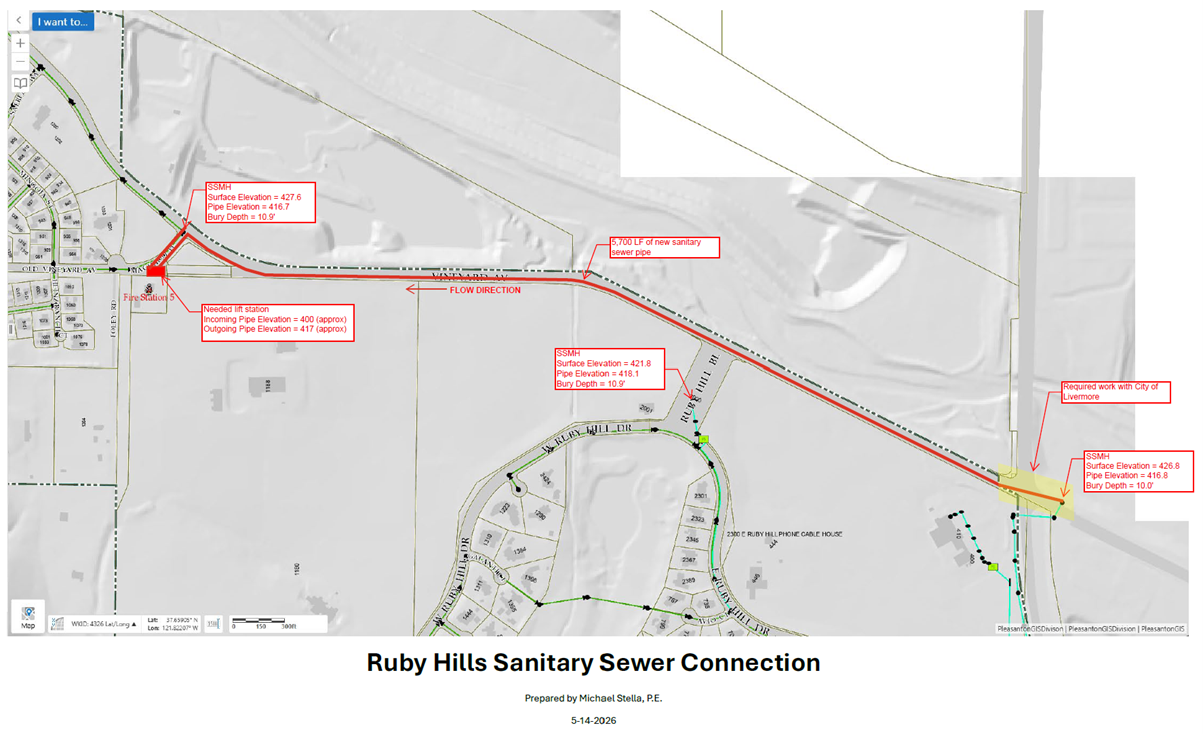
What would it take to shift sewage treatment for Ruby Hill from Livermore to DSRSD?
Connecting Ruby Hills to the City’s sanitary sewer pipe network would require approximately 5,700 lineal feet of new sewer piping in Vineyard Avenue, plus a new lift station near Fire Station 5. The cost for these improvements is significant and must be funded solely by the Ruby Hills community.
Where will sewage from the new project on Vineyard Avenue be treated — DSRSD or Livermore?
The new project (Tract 8724 by Trumark Homes) will connect to the City’s existing sanitary sewer system on Vineyard Avenue. Wastewater from the project will flow through the City’s sewer collection system and be conveyed to DSRSD’s regional wastewater treatment facility for treatment.
Learn More and Stay Informed
- July 9, 2026 Sewer Rate Study Webinar: Recording | Powerpoint
- Attend the 2026 Sewer Rate Information Session at the Pleasanton Senior Center on Thursday, July 23, 2026, from 10:30 a.m. to 11:30 a.m.
- Visit City staff at the Pleasanton Farmers’ Market on Saturday, July 25, 2026, from 9 a.m. to 1 p.m.
- Sign Up for the Pleasanton Pipeline e-Newsletter
- Follow Us on Social Media – Facebook, Instagram
- Submit a Comment or Question via Email at [email protected]
Additional Resources
- Sewer System Management Plan
- Sewer System Long-term Capital Improvement Program
- Financial Plan Staff Report
- Press Release: City Council to Discuss Initial Findings of City’s Comprehensive Sewer Rate Study – April 16, 2026
- 2026 Sewer Rate Study
- Sewer Rate Update Proposition 218 Notice – To be mailed in September